
COLOR ANALYSIS TECH · INDEPENDENT STYLE GUIDE · SEPTEMBER 30, 2026
Kibbe double curve: understand the clothing line
Double curve describes a clothing line with connected rounding through the torso and hips, considered as one silhouette. Online explanations often reduce it to two stacked circles. That picture can introduce the idea, but it is too simple to establish your image identity.
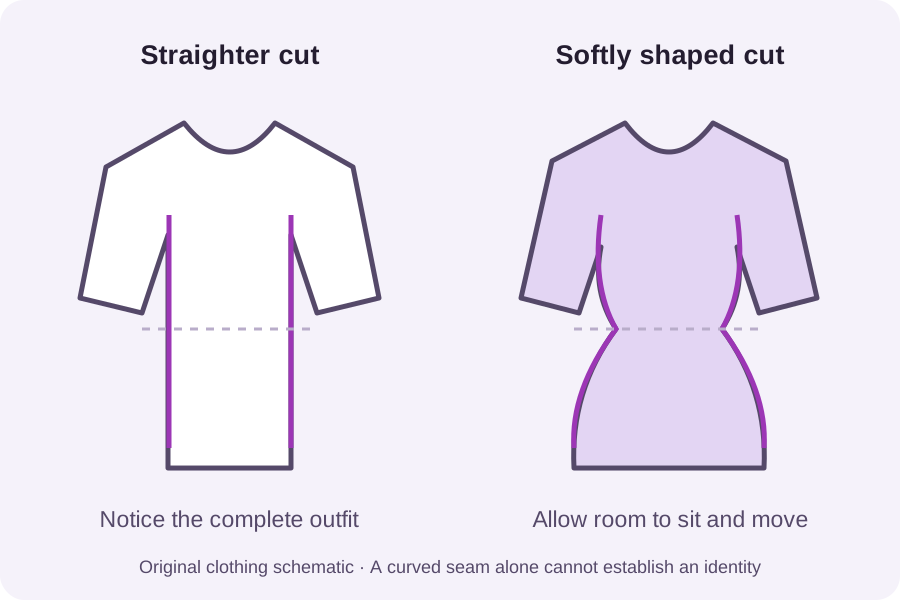
Original clothing schematic: compare straight and curved garment lines. This is an illustration of cuts, not a measurement test or an official personal-line sketch.
Why the explanations can seem contradictory
Kibbe’s approach has evolved, and older online guides use terms differently. His 2025 interview emphasizes the overall personal line and explicitly challenges the habit of splitting it into separate upper and lower curves. Read a guide in the context of the method it discusses rather than combining several incompatible checklists.
Read David Kibbe’s 2025 interview- Are you trying to understand an outfit’s line, or comparing your body to a simplified diagram?
- Does softly shaped fabric work throughout the outfit, including sitting and moving?
- Have you accounted for garment size, bra fit, fabric stretch and camera position before drawing a conclusion?
Double curve, hourglass and vertical
An hourglass label
An hourglass description is usually about the contrast between waist, bust and hips. It does not settle how an entire outfit works, and it is not a shortcut to Romantic or Theatrical Romantic.
A curved clothing line
Compare cuts that follow a rounded path with cuts that hang more straight. Enough room, suitable shaping and fabric movement are useful things to observe. A smaller waist or larger bust is not a pass-or-fail test.
Vertical and curve
A long, continuous outfit can still include curve. In the interview, Kibbe describes length as something the silhouette needs to honor. Seeing curve does not mean you should automatically eliminate a longer style direction.
Three outfit experiments with clothes you own
Our practical styling suggestions. They can help you find outfits you enjoy while your type is still uncertain.
01
Compare two complete looks
With the same comfortable shoes, try a softly shaped top and tapered trousers, then a straighter top and straighter trousers. Keep the size correct in both. Notice the overall line rather than searching for a body part to criticize.
02
Change fabric before buying
If a woven top pulls, compare a soft knit or a woven top with different shaping. Keep your preferred neckline and coverage. A better result may be a fabric or pattern-cutting difference, which is useful even while your type is uncertain.
03
Test a small adjustment
Compare a loose tuck, a soft tie and no waist adjustment. Sit and walk in each version. Record which feels comfortable and looks cohesive with the rest of your outfit; there is no need to force a cinched waist.
Put the idea in context
Get a free AI Kibbe estimate from a full-body photo. The optional full report explains the reasoning, compares alternatives and turns the result into six outfit illustrations and a reusable capsule.
Common questions
Sources and approach
This is an independent explanation with original clothing diagrams and editorial outfit experiments. It is not an official Kibbe consultation or a replacement for the complete method.
- David Kibbe on Style POV, February 13, 2025 — personal line, silhouette and the limits of isolated body-part rules.
- David Kibbe’s Power of Style, Penguin Random House, 2025 — the author’s complete guided process.